



Ceramic Fiber Blanket
Product Introduction
Ceramic fiber blankets are a new type of lightweight refractory and thermal insulation material. Available in various specifications, including standard, high-purity, and zirconium-containing types, they are suitable for different temperature requirements. Combining thermal insulation, fire resistance, and sound absorption capabilities, they are easy to install and exhibit excellent chemical stability. These blankets effectively reduce heat loss in industrial equipment and improve energy efficiency, making them widely applicable in high-temperature insulation projects across multiple industries.
Product Features
Excellent High-Temperature Resistance: Long-term use temperature ranges from 1050°C to 1650°C.
Low Thermal Conductivity and Heat Capacity: Outstanding thermal insulation and energy-saving performance.
Lightweight and Flexible: Easy to cut and install, suitable for complex working conditions.
Superior Thermal Shock Resistance: Resists cracking or spalling under rapid temperature changes.
Excellent Chemical Stability: Resistant to acid and alkali corrosion, free from harmful substances.
High Porosity: Provides effective sound absorption and noise reduction.
Product Applications
Industrial Furnaces and Heating Equipment: Lining for furnace walls and insulation for tops and covers.
Power Industry: Thermal insulation for boilers, gas turbines, and nuclear power equipment.
Chemical Industry: Lining and insulation for high-temperature reactors and pipelines.
Building Fireproofing: Fire-resistant filling for firewalls and fire doors in high-rise buildings.
Metallurgical Industry: High-temperature insulation layers for melting furnaces and ladles.
High-Temperature Filtration: Filter media and sealing for expansion joints in industrial furnaces.
Core Technical Parameters
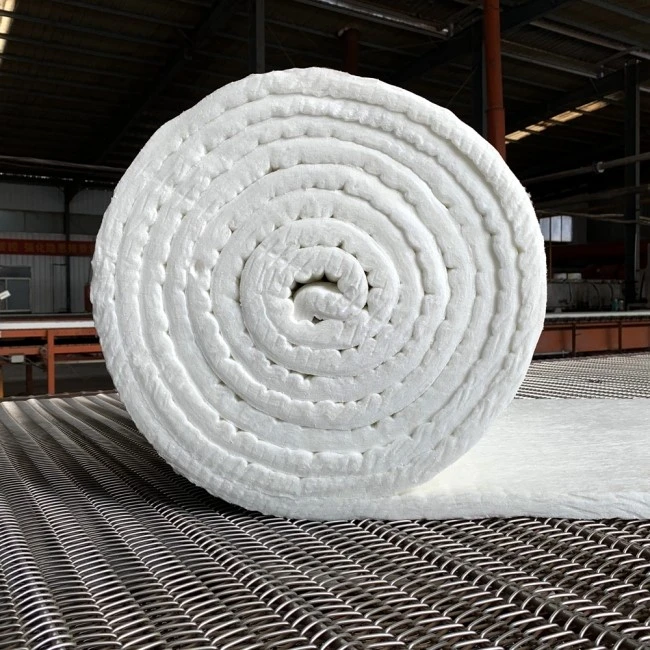
Product Parameters
|
Item |
STD |
HP |
HA |
ZA |
HTZ |
|||
|
Classification Temp (℃) |
1260 |
1260 |
1360 |
1360 |
1430 |
|||
|
Working Temp (℃) |
≤1050 |
≤1100 |
≤1200 |
≤1200 |
≤1350 |
|||
|
Color |
Pure White |
Pure White |
Pure White |
Pure White |
Pure White |
|||
|
Bulk Density (Kg/m3) |
64-160 |
64-160 |
96-160 |
96-160 |
96-160 |
|||
|
Permanent Linear change (%) |
1000℃X24h≤ -3 |
1100℃X24h≤ -3 |
1200℃X24h≤ -3 |
1350℃X24h≤ -3 |
||||
|
Thermal Conductivity (w/m.k) |
400C |
0.095 |
0.095 |
0.114 |
0.114 |
0.122 |
||
|
500C |
0.123 |
0.123 |
0.135 |
0.135 |
0.153 |
|||
|
600C |
0.158 |
0.158 |
0.191 |
0.191 |
0.184 |
|||
|
Tensile Strength (Mpa) |
0.04-0.06 |
0.05-0.075 |
0.05-0.075 |
0.05-0.075 |
0.05-0.075 |
|||
|
Chemical Composition (%) |
AL2O3 |
45-46 |
47-49 |
52-55 |
45-46 |
39-40 |
||
|
AL2O3+SIO2 |
97 |
99 |
99 |
- |
- |
|||
|
AL2O3+SIO2+ZrO2 |
- |
- |
- |
99 |
99 |
|||
|
ZrO2 |
- |
- |
- |
5-7 |
15-17 |
|||
|
Fe2O3 |
≤1.0 |
≤0.2 |
≤0.2 |
≤0.2 |
≤0.2 |
|||
|
Na2O+K2O |
≤0.5 |
≤0.2 |
≤0.2 |
≤0.2 |
≤0.2 |
|||
|
Size(mm) |
Length:3600 & 7200 &14640 Width:610 &1220 |
|||||||
|
Package |
Plastic weaving bag and cartons |
|||||||
|
Certificate |
CE,ISO9001-2008; ISO14001-2004,SGS, ROHS,SASO, REACH |
|||||||
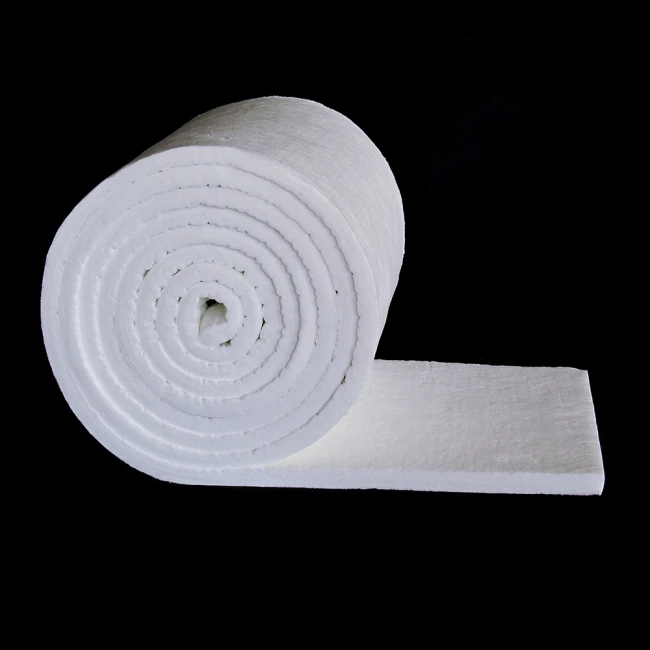
Product Advantages
Customizable Specifications: Products can be tailored in thickness, density, and width based on customer operating conditions to meet personalized construction requirements.
High Cost Performance: Lightweight characteristics reduce transportation and installation costs, while an extended service life minimizes subsequent maintenance and replacement expenses.
Eco-Friendly and Safe: Asbestos-free and free from harmful volatile substances, the production and usage processes comply with environmental standards, ensuring operational safety.
Professional Installation Guide for Ceramic Fiber Blankets
This guide applies to the standardized installation of ceramic fiber blankets in scenarios such as industrial furnaces, pipeline insulation, and equipment heat insulation, aiming to ensure construction quality and maximize the product's thermal insulation and fire resistance performance.
I. Pre-Construction Preparation
Material Verification
Confirm that the model (standard type / high-purity type / zirconium-containing type), specifications (thickness, width, density) of the ceramic fiber blanket match the construction conditions. Check that the blanket is free from damage, moisture, deformation, or other issues.
Tool Preparation
Prepare specialized cutting knives, stainless steel anchors, high-temperature adhesives, tape measures, scrapers, protective gloves, dust masks, and other tools and protective gear.
Surface Treatment
Clean oil stains, dust, rust, and loose impurities from the construction surface. Ensure the surface is flat, dry, firm, and free from hollowing. For high-temperature equipment, cool it to room temperature in advance.
II. Installation Steps
Precise Cutting
Cut the ceramic fiber blanket according to the dimensions of the construction surface using a specialized cutting knife. Keep the cut edges straight and reserve an expansion allowance of 5–10mm to avoid bulging due to tight splicing under high temperatures.
Selection of Fixation Methods
Anchor Fixation (Applicable to furnace linings and large equipment):
Drill holes in the base at intervals of 200–300mm and install stainless steel anchors to ensure they are firm and not loose.
Press the ceramic fiber blanket tightly against the base, covering the anchors, and secure the blanket with pressure plates to prevent detachment.
For multi-layer installation, stagger the seams of upper and lower layers by at least 100mm, and avoid continuous seams.
Adhesive Fixation (Applicable to pipelines and small equipment):
Evenly apply high-temperature adhesive to the base, with a thickness of 2–3mm.
Smoothly place the ceramic fiber blanket onto the adhesive layer, compact it with a scraper, and expel air between the blanket and the base.
For pipeline wrapping, tightly wrap from one end to the other, with an overlap width of at least 50mm.
Seam Treatment
Fill the seams between adjacent blankets thoroughly with high-temperature adhesive and seal the surface with ceramic fiber tape to ensure no gaps and prevent heat leakage.
Surface Protection (Optional)
For areas prone to mechanical impact, install stainless steel mesh or metal guards to extend the service life of the ceramic fiber blanket.
III. Construction Precautions
Construction Environment
Avoid construction in rainy or high-humidity conditions. The construction temperature should be controlled between 5–35°C to prevent poor adhesive curing.
Safety Protection
Construction personnel must wear dust masks and protective gloves to avoid inhaling fiber dust or direct skin contact that may cause discomfort. Clean up dust promptly after construction and maintain ventilation in the work area.
Curing Requirements
After installation, allow natural curing for at least 24 hours before use. For high-temperature equipment, the initial temperature increase should be gradual to avoid sudden temperature spikes that may cause blanket cracking.
Prohibited Actions
Do not apply non-high-temperature coatings on the surface of ceramic fiber blankets. Avoid scratching the blanket with sharp objects. Do not install damp ceramic fiber blankets directly.
IV. Quality Acceptance Standards
The blanket is laid flat, free from wrinkles, hollowing, or edge warping, with tight and gap-free seams.
Anchors are evenly spaced, firmly fixed, and free from loosening or detachment.
The overall insulation layer thickness meets design requirements, with a deviation not exceeding ±5mm.
FAQ
Q1: What is the long-term operating temperature range for ceramic fiber blankets?
A1: The temperature resistance varies by model. The standard type has a long-term operating temperature of ≤1050°C, the high-purity type ≤1100°C, and the zirconium-containing type up to 1650°C. The appropriate model can be selected based on the operating conditions.
Q2: Do ceramic fiber blankets contain asbestos? Are they environmentally friendly and safe?
A2: The product is made from high-purity aluminum silicate raw materials and does not contain any asbestos components. It is free from harmful volatile substances, complies with domestic and international environmental and safety standards, and poses no health risks during installation and use.
Q3: Can ceramic fiber blankets be customized in size?
A3: Yes, customization is supported. The standard widths are 610mm and 1220mm, with thicknesses ranging from 20mm to 100mm. Products can be cut to different lengths and densities based on customer requirements to meet personalized construction needs.
Q4: What are the installation methods for ceramic fiber blankets?
A4: There are two main methods. For large industrial furnaces and similar scenarios, stainless steel anchors are used for fixation. For pipelines and small equipment, high-temperature adhesives can be applied for laying or wrapping. For multi-layer installations, seams must be staggered.
Q5: Can ceramic fiber blankets still be used if they get damp?
A5: If dampened for a short period, they can be thoroughly dried at room temperature and used without affecting performance. However, if long-term soaking has caused structural looseness, replacement is recommended to avoid compromising thermal insulation effectiveness.
Q6: Can ceramic fiber blankets be used for fire barrier wall filling?
A6: Yes, the product offers excellent fire resistance, thermal insulation, and sound absorption properties. It is an ideal filling material for fire barrier walls and fire doors in high-rise buildings and industrial plants, effectively preventing the spread of fire.
Hot Tags: ceramic fiber blanket, China ceramic fiber blanket manufacturers, factory
You Might Also Like
Send Inquiry