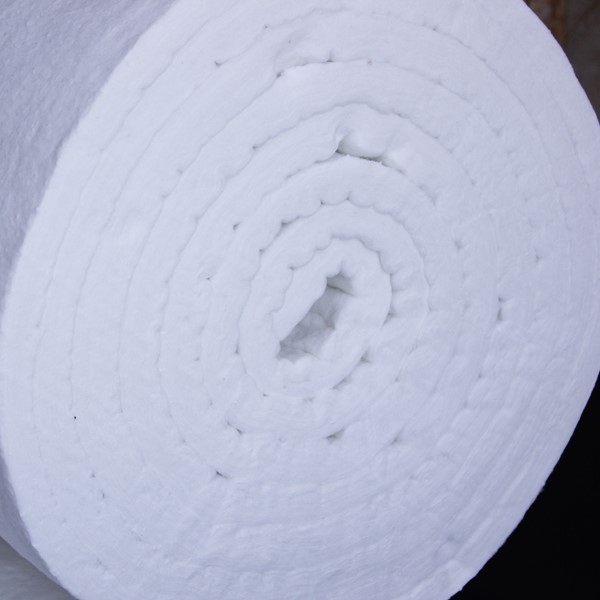

I. The Fire Resistance and Thermal Insulation Principles of Ceramic Fiber Blankets
The exceptional fire resistance and thermal insulation properties of ceramic fiber blankets primarily stem from their unique physical structure:
Low Thermal Conductivity
The ceramic fibers are arranged in a disordered, intertwined manner, creating a tortuous and complex path for heat to travel along the fibers, making rapid conduction difficult. Furthermore, when the fibers contact a heat source, they are mostly in a non-perpendicular orientation, which further impedes heat transfer. The contact points between fibers account for up to 80% of the structure, increasing thermal resistance. Additionally, the ceramic fibers themselves are opaque, effectively blocking the propagation of radiant heat. Coupled with their small surface area and limited ability to absorb radiation, heat transfer via radiation is also significantly suppressed.
Significant Gas Barrier Effect
The interwoven fibers form numerous closed air chambers filled with stagnant air. Air itself has poor thermal conductivity, and stagnant air is even less likely to form effective convection. These air chambers not only slow down heat transfer via convection but also block the direct intrusion of high-temperature gases, thereby enhancing the overall thermal insulation effect.
II. Why Are Ceramic Fiber Blankets "Afraid of Water"?
Although ceramic fiber blankets themselves have low water absorption, they remain relatively sensitive to environmental humidity due to their large specific surface area. Therefore, strict moisture-proof and rain-proof measures must be taken during storage and transportation, and environmental humidity must be controlled.
Additionally, friction during the production and processing of ceramic fibers can easily generate static electricity. The static phenomenon in ceramic fibers is more pronounced than in natural and organic fibers, which also imposes higher requirements on the storage environment.
III. Structure Determines Properties: Differential Response to Water and Fire
The fundamental properties of ceramic fiber blankets are determined by their microstructure. The interwoven fibers create numerous pores. The stagnant air within these pores has extremely low thermal conductivity, forming an efficient insulating layer. Once moisture enters these pores, it displaces the original stagnant air. Since water's thermal conductivity is much higher than that of air, this significantly reduces the blanket's insulating effectiveness.
Therefore, ceramic fiber blankets are "not afraid of fire" thanks to their air-based fibrous structure; they are "afraid of water" because moisture intrusion disrupts the stagnant air layers within the pores, leading to a marked decline in thermal insulation performance.