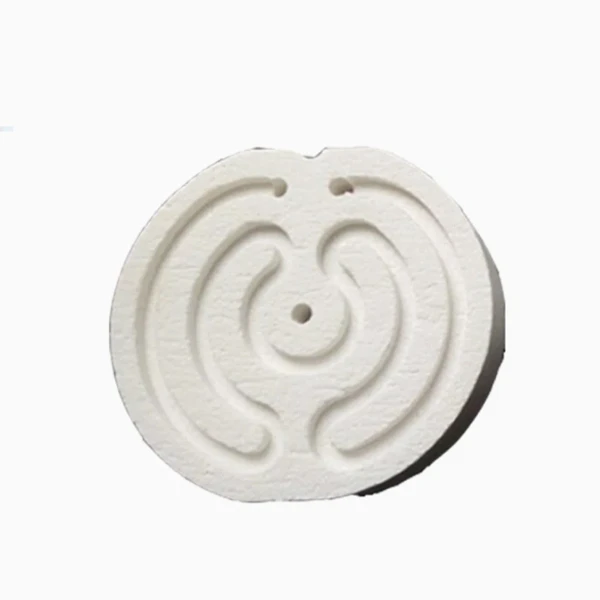

1. Raw Material Melting and Fiberization
Magnesite and wollastonite are used as the primary raw materials, with calcium-magnesium oxides added. The mixture is melted in an arc furnace at 1700-1900°C and then stretched into fibers using high-speed spinning rollers (120-180 m/s). The resulting fibers are fine in diameter and exhibit high tensile strength (1.8-2.2 MPa).
2. Slurry Preparation and Functional Enhancement
The loose fiber cotton is dispersed in water, and a dispersing agent is added to form a slurry. Auxiliary fibers (e.g., silver fibers for antibacterial properties, zirconium boride for high-temperature resistance) and a resin binder (8 wt%) are mixed in to create a stable slurry.
3. Vacuum Filtration Molding
The slurry is poured into custom molds (precision ±0.5 mm), and a vacuum negative pressure (≤ -0.08 MPa) is applied to deposit the fibers. The oriented arrangement enhances thermal shock resistance, forming the initial shape of the special-shaped component.
4. Drying and Shaping
The components are dried at a low temperature of 150°C for 15-20 hours to remove moisture and prevent cracking. Mechanical polishing or laser cutting is used to refine the surface, ensuring dimensional accuracy (±1 mm) and surface roughness (Ra ≤ 6.3 μm).
5. Calcination and Strengthening
The components are calcined at 1600°C for 30 minutes to crystallize the fibers, improving temperature resistance (linear shrinkage ≤ 3.5% at 1260°C) and wind erosion resistance. Refractory mud or ceramic coatings are applied as needed to enhance performance.
6. Inspection and Packaging
Thermal conductivity (0.032-0.038 W/m·K), tensile strength, and other parameters are tested. After meeting environmental standards (ISO 22459), the components are packaged with moisture-proof materials for shipment.