



Refractory Thermal Insulation Material – Soluble Ceramic Fiber Cotton

Refractory Thermal Insulation Material – Soluble Ceramic Fiber Cotton suppliers

Refractory Thermal Insulation Material – Soluble Ceramic Fiber Cotton factory

Refractory Thermal Insulation Material – Soluble Ceramic Fiber Cotton best
Refractory Thermal Insulation Material – Soluble Ceramic Fiber Cotton high quality
Refractory Thermal Insulation Material – Soluble Ceramic Fiber Cotton
Product Introduction
As an advanced eco-friendly insulation material, soluble fiber cotton is widely used in metallurgy, power generation, chemical industries, furnace manufacturing, and high-temperature equipment insulation.
It meets strict international environmental standards and, due to its water-soluble characteristics, significantly reduces dust hazards during installation and use, ensuring operator health and safety.
SUNTHERM's soluble fiber cotton products, with outstanding physical properties and environmental advantages, have been exported to more than 80 countries and regions including Russia, Europe, the United States, the Middle East, and Southeast Asia, earning high recognition from customers.
Composition and Raw Materials
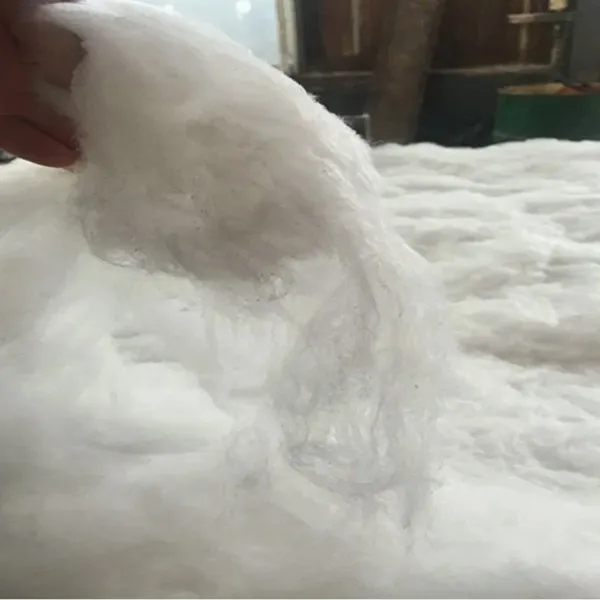
The main components of soluble fiber cotton are high-purity alumina (Al₂O₃) and silica (SiO₂), which are melted at high temperatures in specific proportions to form fine inorganic fibers as thin as hair.
These fibers exhibit excellent high-temperature resistance and chemical stability.
Its unique water-soluble design is achieved by adjusting the chemical composition of the fibers, allowing partial solubility in water, thereby reducing airborne dust concentration during use.
Raw materials are selected from natural minerals and undergo multiple screening and purification processes to ensure high purity and stable performance. All auxiliary materials meet environmental safety standards and are free from asbestos and other harmful substances.
Production Process
(1) High-Temperature Melting
Raw materials are melted into a homogeneous liquid at temperatures above 1600°C.
(2) Fiber Spinning Formation
The molten liquid is processed through high-speed centrifugal spinning to form continuous fibers with a diameter of approximately 2–5 microns.
(3) Fiber Deposition into Cotton
Fibers are deposited in the form of a fiber web and cooled to form an inorganic fiber cotton layer.
(4) Curing and Cutting
After drying and curing, the fiber cotton achieves the required mechanical strength and dimensional stability, followed by cutting and packaging.
(5) Quality Inspection
Each batch undergoes physical performance testing, chemical composition analysis, and environmental compliance testing to ensure standard conformity.
Physical and Chemical Properties
|
Parameter |
Specification |
Description |
|
Working Temperature |
≤1260℃ |
Meets the requirements of high-temperature industrial applications |
|
Fiber Diameter |
2-5μm |
Excellent thermal resistance and mechanical properties |
|
Density |
64-128 kg/m³ |
Adjustable according to requirements |
|
Thermal Conductivity |
≤0.14 W/m·K (800℃) |
Superior thermal insulation performance |
|
Moisture Content |
≤1.0% |
Keeps the material dry |
|
pH Value |
8-10 |
Slightly alkaline, eco-friendly and non-irritating |
|
Tensile Strength |
≥15 KPa |
Ensures mechanical integrity during construction and service |
|
Water Solubility |
Partially water-soluble |
Effectively reduces construction dust and environmental pollution |
Its high-temperature resistance makes it suitable for extreme working environments. Low thermal conductivity reduces heat loss and improves energy efficiency. Excellent mechanical properties ensure stability even under high-temperature vibration conditions.

Environmental Protection and Safety
Soluble fiber cotton complies with multiple international environmental standards, including EU RoHS and REACH certifications.
Its water-soluble design significantly reduces fiber dust release during installation and use, minimizing respiratory hazards and ensuring worker health.
The product is asbestos-free and contains no harmful heavy metals. Waste materials can be safely disposed of, making it environmentally friendly.
Additionally, its moderate pH value prevents corrosion to equipment and surrounding environments. Safety tests confirm that it is non-toxic and non-sensitizing, making it an ideal choice for modern green buildings and industrial insulation systems.
Specifications and Packaging
Standard Specifications
Density: 64–128 kg/m³
Thickness: 1–50 mm (customizable)
Fiber Diameter: 2–5 microns
Dimensions: Custom-cut according to customer requirements
Packaging Method
Moisture-proof plastic film sealed packaging ensures dryness and integrity during transportation. Vacuum packaging or customized packaging solutions are available upon request.
Applications
Metallurgical Industry: Blast furnaces, converters, electric furnaces, and steelmaking furnace linings
Chemical Industry: High-temperature reactors, pipelines, and equipment insulation
Power Industry: Boilers, heat exchangers, and chimney insulation
Construction Industry: Energy-efficient building insulation materials
Furnace Manufacturing: Ceramic and glass kilns insulation
Aerospace: High-temperature protection materials and thermal insulation layers
Its excellent temperature resistance and environmental advantages make it an ideal choice for various high-temperature applications.
Installation and Maintenance Guide
(1) Installation
Wear protective gloves and masks during installation
Ensure uniform and dense placement to avoid thermal bridges
Use dedicated fasteners or mesh reinforcement for long-term stability
(2) Maintenance
Avoid prolonged exposure to humid environments
Regularly inspect insulation integrity and repair damages promptly
Maintain proper ventilation to extend service life
Typical Case Studies
Case 1: Large Steel Plant Blast Furnace Lining
After replacing traditional insulation materials with soluble fiber cotton, thermal efficiency increased by 15% and energy consumption decreased by 20%, significantly reducing production costs.
Case 2: High-Temperature Reactor in a Middle Eastern Chemical Plant
The use of soluble fiber cotton improved equipment safety and operational stability, ensuring continuous production.

FAQ
Q1: What is the maximum service temperature?
A1: Up to 1260°C, suitable for various high-temperature industrial environments.
Q2: Is the product environmentally safe?
A2: Yes, it complies with EU RoHS and REACH standards, and its water-soluble design reduces dust hazards.
Q3: Can specifications be customized?
A3: Yes, thickness, density, and dimensions can be customized according to requirements.
Q4: What precautions should be taken during installation?
A4: Wear protective equipment, ensure ventilation, and avoid inhaling dust.
Q5: What are the key advantages?
A5: Excellent heat resistance, superior insulation performance, eco-friendly, water-soluble, and safe.
SUNTHERM Group Strength
Founded in 1993, SUNTHERM Group operates three modern production bases: production line equipment factory, rock wool factory, and ceramic fiber factory.
The group specializes in the R&D, manufacturing, and sales of high-temperature insulation materials, including soluble fiber cotton, ceramic fiber blankets, rock wool boards, and production line equipment.
With over 30 years of industry experience, the company is equipped with advanced international production and testing equipment and a strong technical team. Its products have passed multiple international certifications such as ISO9001 and are exported to over 80 countries and regions worldwide.
SUNTHERM is committed to providing high-quality, eco-friendly, and energy-saving insulation solutions, along with comprehensive technical support and after-sales services. The group's factories cover an area of approximately 1,000 mu, offering strong production capacity and innovation capabilities.
Hot Tags: refractory thermal insulation material – soluble ceramic fiber cotton, China refractory thermal insulation material – soluble ceramic fiber cotton manufacturers, factory
You Might Also Like
Send Inquiry