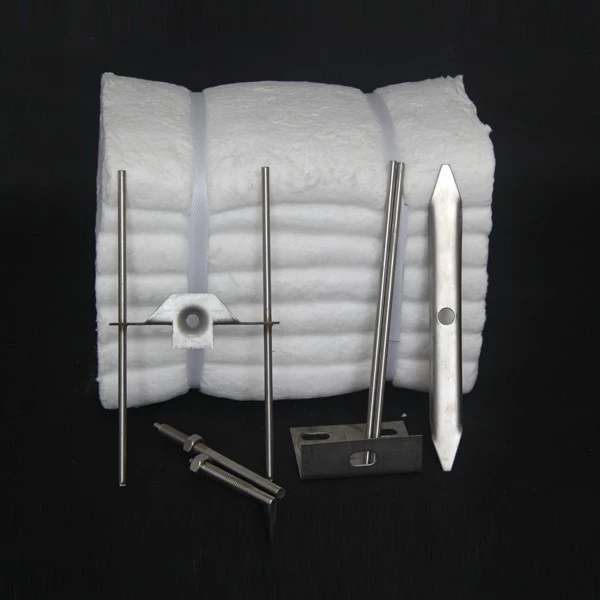

Ceramic fiber modules are advanced refractory insulation products designed to simplify furnace construction, accelerate installation, and enhance the overall integrity of furnace linings. With their bright white appearance and regular shape, these modules can be directly fixed onto anchoring studs welded to the steel shell of industrial furnaces. In addition to excellent refractory and thermal insulation performance, they significantly improve lining integrity and airtightness, contributing to the advancement of furnace lining construction technology.
In terms of chemical stability, ceramic fiber modules generally perform well and exhibit a certain degree of resistance to acid and alkali corrosion. However, their application is restricted in furnace environments containing the following specific substances or atmospheres, where their use is not recommended:
Fluorine and Fluorides
Fluorine is highly corrosive to ceramic fiber materials and can react with all aluminosilicate-based materials (including mullite fibers), leading to structural degradation and damage.
Vanadium and Other Heavy Metals
During the combustion of low-quality fuel oil, vanadium and other heavy metal oxides (such as vanadium pentoxide, V₂O₅) are produced. These oxides melt at around 690 °C and tend to adhere to the porous surfaces of ceramic fibers, forming hard crusts that peel off layer by layer, continuously attacking and eroding the fiber lining.
Sulfur and Sulfuric Acid
Although sulfuric acid does not directly react with ceramic fibers, it is highly corrosive to metal anchoring components and the furnace shell. Long-term exposure may even result in failure of the anchoring system.
Alkali Metals
Prolonged use in alkaline environments can cause gradual shrinkage of the ceramic fiber lining, loosening of the structure, and surface spalling, with corrosion progressively penetrating deeper into the lining.
Phosphoric Acid
Experimental studies have shown that long-term operation in environments containing phosphoric acid at temperatures above 540 °C may lead to noticeable shrinkage of ceramic fiber modules, thereby compromising the stability of the furnace lining.
Understanding these limitations is essential for the correct selection and long-term reliable application of ceramic fiber modules in industrial furnace systems.