



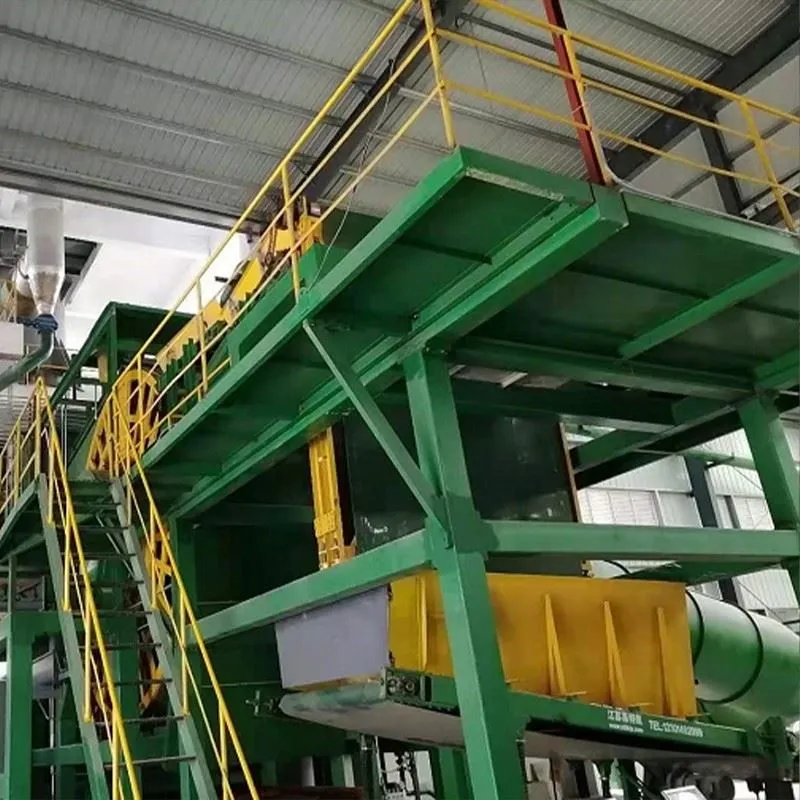
New Natural Gas Furnace Rock Wool Production Line
Product Introduction
Core Equipment Components
The complete production line consists of six integrated systems that enable continuous and automated production:
1. Raw Material Pre-treatment System
Includes jaw crushers, vibrating screens, batching silos, weighing conveyors, and mixers. This system handles crushing, screening, precise proportioning, and uniform mixing of basalt, dolomite, slag, and other raw materials to ensure consistent composition.
2. Natural Gas High-Temperature Melting System (Core System)
Includes a natural gas tank melting furnace (1450–1600°C), high-speed burners, automatic air-fuel ratio control systems, and flue gas waste heat recovery devices. This system ensures complete melting of raw materials, uniform melt temperature, and maximum thermal efficiency.
3. Centrifugal Fiberizing System
Consists of a four-roller high-speed centrifuge (3000–6000 rpm), fiber blowing systems, and slag ball separation devices. Molten material is spun into ultra-fine inorganic fibers (3–7 μm) with slag ball content ≤7%, ensuring high fiber uniformity.
4. Fiber Collection and Binder Application System
Includes negative pressure fiber collectors, 3D binder spraying systems, and water-repellent and anti-dust oil atomization systems. Fibers are evenly collected and sprayed with phenolic resin binders and waterproofing agents with precise binder ratio control.
5. Pendulum Forming and Curing System
Includes pendulum fiber distributors, pleating machines, and continuous curing furnaces (200–300°C). Through cross-layer fiber distribution and compression, a three-dimensional random fiber structure is formed. High-temperature curing crosslinks the binder to ensure board strength and density consistency.
6. Post-processing and Packaging System
Includes cooling sections, longitudinal and cross cutting machines, edge trimming equipment, stacking machines, heat-shrink packaging machines, and automatic control systems. Products are cut to specifications (thickness 30–200 mm, density 60–200 kg/m³), cooled, packaged, and stored.
Product Performance Features
Core Advantages of the Natural Gas Heating System
1. High Efficiency and Energy Savings
Natural gas provides complete combustion and stable calorific value (8500 kcal/Nm³). Combined with precise air-fuel ratio control and waste heat recovery (for combustion air and raw material preheating), thermal efficiency improves by more than 25% compared to traditional coke furnaces, while energy consumption per ton is reduced by 15–20%. Long-term operating costs are significantly lower than electric or coke furnace systems.
2. Environmental Compliance and Clean Emissions
Natural gas is a clean energy source, producing mainly CO₂ and H₂O, with minimal sulfur, nitrogen oxides, or dust emissions. With flue gas purification, dust removal, and desulfurization systems, emissions fully comply with environmental standards such as GB 16297 and GB 9078. No complex exhaust treatment is required, making environmental approvals easier.
3. Precise Temperature Control and Uniform Melt
Dual cross temperature control and multi-point temperature monitoring ensure furnace temperature fluctuations within ±10°C. Stable melt composition and viscosity ensure consistent fiber fineness, uniformity, and slag ball content, resulting in excellent product consistency.
4. Safe and Stable Operation
Features include a fully enclosed furnace structure, flameout protection, pressure interlocks, emergency shut-off valves, and explosion-proof devices. The system complies with gas safety regulations and offers easy maintenance with low failure rates.
Overall Production Line Advantages
1. High Automation and Labor Efficiency
The entire line is controlled by an intelligent PLC system covering batching, melting, fiberizing, and packaging. Only 3–5 operators are required, increasing production efficiency by about 30% and significantly reducing labor costs.
2. Excellent Product Quality
Produced rock wool meets A-class non-combustibility standards (GB 8624) and satisfies high-end application requirements in construction, industry, and shipbuilding.
3. Flexible Customization
Fiber diameter, density, thickness, and binder content can be flexibly adjusted to produce various products including rock wool boards, blankets, pipes, and fire barrier strips.
4. Compact Structure and Flexible Layout
The modular design allows flexible plant layout configurations (L-shape or straight line), reducing infrastructure investment and enabling short installation cycles (45–60 days).
Main Application Areas
Rock wool products produced by this line offer A-class fire resistance, efficient insulation, sound absorption, corrosion resistance, and temperature stability, making them suitable for:
Construction Sector (Primary Application)
Exterior wall insulation systems
Roof thermal insulation
Fire barrier systems
Curtain wall insulation
Interior wall soundproofing
Floor insulation
Fire protection for steel structures
Compliant with building fire protection and energy efficiency standards such as GB 50016 and GB 50176, suitable for residential buildings, commercial complexes, factories, and cold storage facilities.
Industrial Sector
Power industry: Thermal insulation for boilers, turbines, pipelines, and chimneys
Petrochemical: Refineries, storage tanks, reactors, and pipelines
Metallurgy: Blast furnaces, hot blast stoves, heat treatment furnaces, and high-temperature pipelines
Equipment: Industrial furnaces, drying equipment, refrigeration systems, and pressure vessels
Transportation and Marine Sector
Shipbuilding: Fire protection and insulation for cabins, decks, engine rooms, and pipelines (IMO compliant)
Rail transit: Fireproofing and insulation for high-speed rail, metro cars, and tunnels
Other Fields
Agriculture: Greenhouse insulation and livestock building insulation
Environmental protection: Flue gas ducts and dust collection equipment insulation
Fire protection: Fire door cores and fire stopping materials
Production Process Flow (Natural Gas Furnace Rock Wool Process)
Step 1 – Raw Material Preparation
Basalt, dolomite, and slag → jaw crushing → vibrating screening (impurity removal) → precise batching → mixing → transfer to furnace storage bin.
Step 2 – Natural Gas High-Temperature Melting (Core Process)
Mixed materials → continuous feeding into furnace → natural gas combustion with preheated air (500–800°C) → furnace temperature reaches 1450–1600°C → complete melting into uniform liquid → stable temperature and level control → melt flows into centrifuge.
Step 3 – High-Speed Fiberizing
Molten material → four-roller centrifuge (3000–6000 rpm) → air cooling → formation of 3–7 μm fibers → slag removal → fibers enter collection chamber.
Step 4 – Fiber Collection and Binder Spraying
Negative pressure collection → 3D atomized binder spraying (phenolic resin, water repellent, anti-dust oil) → binder content precisely controlled (2–5%) → formation of primary fiber mat.
Step 5 – Pendulum Forming and Pleating
Fiber mat distributed in multiple layers → pendulum layering → differential speed pleating → formation of 3D random fiber structure → improved tensile and compressive strength.
Step 6 – High-Temperature Curing
Fiber mat enters curing furnace → 200–300°C hot air curing → binder crosslinking → structural stabilization → continuous rock wool boards/blankets formed → cooling to room temperature.
Step 7 – Post-processing and Packaging
Cooling → longitudinal and transverse cutting → trimming → quality inspection (density, thickness, fire rating, thermal conductivity) → automatic stacking → heat-shrink packaging → warehousing and shipment.
FAQ
Q1: What advantages does a natural gas rock wool production line have compared with coke or electric furnaces?
A:
① Energy savings: Lower gas consumption and efficient waste heat recovery reduce long-term operating costs by 15–20% compared to coke furnaces and over 30% compared to electric furnaces.
② Environmental compliance: Clean combustion simplifies emission treatment and environmental approval.
③ Stable quality: Precise temperature control ensures consistent fiber quality and lower slag content.
④ Safety and maintenance: Complete gas safety systems, long furnace lining life, and easy daily maintenance.
Q2: What are the space, power, and plant height requirements?
A: For a 10,000-ton/year line:
Area: about 1200–1800 m² (L-layout)
Workshop height: ≥8 m (≥10 m for furnace section)
Installed power: about 500 kW
Specific requirements depend on capacity and layout. Free plant layout design is available.
Q3: How are dust and exhaust gases treated? Can the line pass environmental inspections?
A: The entire line operates under fully enclosed negative pressure. Dust collection systems are installed at batching, fiber collection, and cutting sections. Natural gas combustion produces clean exhaust, and with waste heat recovery and purification systems, emissions fully meet national and local environmental standards. Under standard configurations, environmental approval and inspection can be successfully achieved.
Hot Tags: new natural gas furnace rock wool production line, China new natural gas furnace rock wool production line manufacturers, factory
You Might Also Like
Send Inquiry